UKRI Dispatches 500 Students for Community Service Program
The Universitas Kebangsaan
Republik Indonesia (UKRI) has dispatched 545 students to take part in it’s 2026
Community Service Program (Kuliah Kerja Nyata/KKN), marking the beginning of a
month-long initiative aimed at supporting rural development across Bandung
Regency, West Java.
The official send-off ceremony
was held on Monday (July 20) at the university's Rectorate Building, where
university leaders, faculty members, and student representatives gathered ahead
of the students deployment to 10 villages.
Held under the theme "Strengthening
Food Security and Rural Economies through the Downstream Development of Local
Products toward Sustainable Independent Villages," this year's KKN
program focuses on helping communities unlock the value of local resources
while encouraging sustainable economic growth. Students from a range of
academic disciplines will work alongside village residents to develop
community-based solutions, applying what they have learned in the classroom to
real-life challenges.
Speaking at the ceremony, Head of
UKRI's Institute for Research and Community Service (LPPM), Saumi Zikriani
Ramdhani, S.Si., M.Si., described the program as an important expression of
the university's commitment to serving society.
"Through KKN, UKRI
contributes to community development by strengthening local potential,
increasing the value of village products, and promoting sustainable community
empowerment," she said.
The students were officially
dispatched by Vice Rector for Academic Affairs Dr. Heni Haryani, S.Pd.,
M.Hum., who encouraged them to carry out their responsibilities with
integrity, professionalism, and respect for the communities they will serve.
She emphasized that the program
is designed not only to fulfill academic requirements but also to cultivate
leadership, empathy, and social responsibility among students.
"KKN is more than a
graduation requirement. It is an opportunity for our students to learn directly
from the community while making meaningful contributions through their
knowledge and skills," she said.
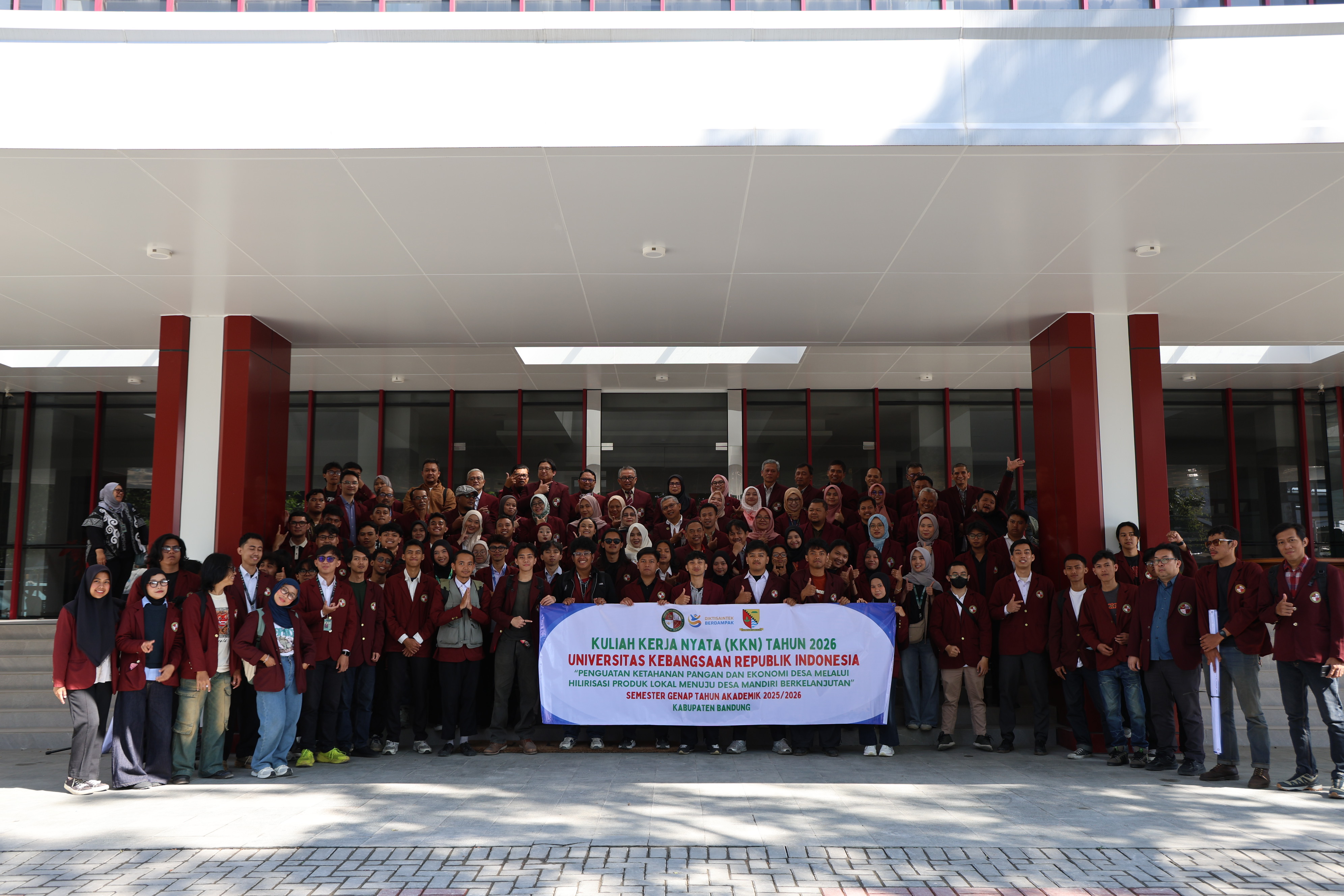
The ceremony concluded with the
symbolic presentation of KKN attributes to student representatives by Vice
Rector for Student Affairs Suhaeri, S.Sos., M.I.Kom. before participants
posed for a group photograph with the program's 30 Field Supervisors (DPL).
Over the next month, the
supervisors will accompany and mentor students in the field, ensuring that each
community project is implemented effectively and delivers lasting benefits to
the villages involved.
As the students begin their
assignments, the 2026 KKN program represents another step in UKRI's broader
mission to connect higher education with the needs of society—encouraging
students not only to apply their academic knowledge, but also to become active
partners in sustainable community development.